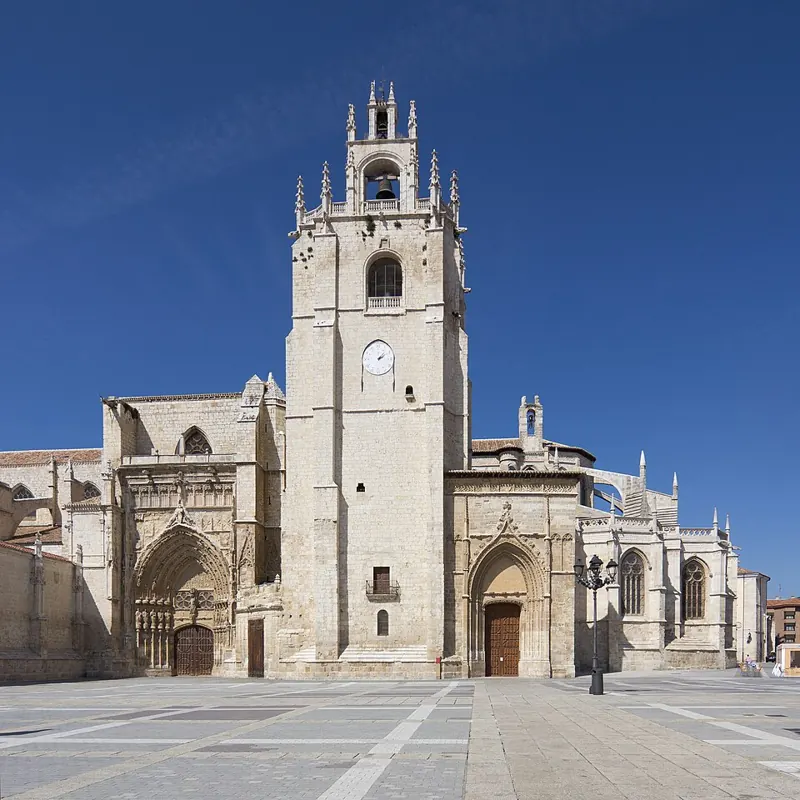
Palencia unfolds between San Antolín Cathedral, shopping arcades and the Carrión river. Eight stops combine heritage with green breaks, without requiring entry to every church. Cristo del Otero is outside this walk: verify construction restrictions before planning an ascent.
Palencia
Choose what fits your visit
Three decisions to organise the day without turning it into a checklist of tickets. Routes and time allowances are editorial suggestions; adjust the order to your bookings and pace.
01
Cathedral and Carrión: prioritise two sides of Palencia
For a short stay, choose the cathedral as your main visit and Puentecillas for a contrasting view beside the Carrión. Calle Mayor then returns you to the urban scene without adding another collection. This combines architecture and river rather than every central church. If the cathedral is your main interest, check its visit options and shorten the riverside section before the morning becomes a race.
Huerta de Guadián or San Pablo: choose your ending
From the centre, Huerta de Guadián and San Pablo draw the walk in different directions. Choose the park for a green break or San Pablo to continue exploring the city’s religious heritage. You do not need both for a complete visit. Decide where you want to eat or return afterwards: that endpoint is more useful than adding monuments without considering the way back.
San Miguel: appreciate the tower without assuming a climb
San Miguel’s tower gives you a reason to pause near the river, but a visible facade does not establish an interior visit or tower climb. Use it as a landmark between the Carrión and central streets, checking any admission before relying on it. If you have already chosen the cathedral, this exterior adds another architectural profile without making a second ticket a requirement.
Begin at San Pablo and the cathedral, then continue to Plaza Mayor. Follow Calle Mayor’s arcades to the Provincial Palace. Give the cathedral interior its own visiting block rather than treating it as a brief stop between façade photographs.
Start at Puentecillas to see Palencia’s relationship with the Carrión. Visit San Miguel’s surroundings, then cross the centre towards Huerta de Guadián. This makes an easier second morning with fewer interiors and more rests; you need not cover every riverside and park path.
Combine the village, visitor centre and birdwatching at La Nava. Seasonal conditions change the experience; bring binoculars and check which hides are accessible.
By car; plan parking and your return before setting out.
Choose one canal section rather than its full length. Fuentes de Nava gives access to the Campos branch; any boat trip needs a separately checked departure point and booking.
By car; plan parking and your return before setting out.
Choose arcade detail-spotting and a Huerta de Guadián stroll with a generous play break. Select a few cathedral spaces instead of an exhaustive visit. Puentecillas adds river scenery without requiring a full riverside circuit.
In the rain
Make the cathedral a proper main visit rather than brief shelter. Palencia Museum offers another view of provincial history. Choose one or both according to opening times, using Calle Mayor as a transition; its arcades do not cover the entire route.
What to try and where to pause
Calle Mayor and Plaza Mayor keep meals on-route. For roast suckling lamb reserve a seated meal and ask if advance ordering is required; for a brief visit choose tapas rather than squeezing an asador between trains.
Sources for this update
Turismo del Ayuntamiento de Palencia · patrimonio de palencia
catedraldepalencia.org · patrimonio de palencia
Turismo de la Diputación de Palencia · patrimonio de palencia
Turismo de la Diputación de Palencia · Ampudia
Turismo de la Diputación de Palencia · Fuentes de Nava
Turismo de la Diputación de Palencia · Canal de Castilla
Choose your walk
Durations are indicative: queues and all indoor visits are not included.
Plan my route
Street map
OpenStreetMap loads on request. Markers are indicative, not audited entrances. Use links for street directions.
The cathedral’s history begins below ground. Its crypt combines two spaces, one from the seventh century and another enlarged in the eleventh; the great Gothic church rose above them after its foundation stone was laid in 1321. These overlapping layers explain the visit better than a list of architectural styles. Walk around the building first, comparing the horizontal sweep of its walls with the height you experience inside. Then choose a viewpoint from which to follow pillars and vaults. If you visit the crypt, reconsider that contrast in scale: the intimate underground space and the great church describe different moments within one continuing history, with neither replacing the other.
Plaza Mayor organises civic life through an easily recognised composition: arcades on three sides and the town hall closing the fourth. The Neoclassical building opened in 1878; Victorio Macho’s monument to Alonso Berruguete stands before it. Begin beneath the arcades, then move towards the centre to compare the perspectives. The contrast between the monument’s dark figure and pale stone makes it recognisable even from a distance. Next, notice how the municipal façade provides a backdrop for the whole composition. Conversations, pedestrians and terraces are part of the visit too: its appeal lies in this meeting of an institutional setting and everyday public space before you continue towards Calle Mayor.
San Miguel stands out for its battlemented tower, suggesting a defensive building although it belongs to a church. The structure developed from a Romanesque predecessor during the thirteenth century, adopting Gothic forms. Tradition places the wedding of El Cid and Doña Jimena here: this is a legend, not a proven historical event. Start at the far end of the square to appreciate how strongly the tower dominates the church. Then seek the large belfry openings and compare their lightness with the battlements above. If you enter, follow the columns upwards towards the vaults. The shift between exterior silhouette and interior space explains more than simply noticing its resemblance to a castle.
San Pablo reveals several faces before you cross its doorway. Its present form combines fourteenth- and sixteenth-century phases, with a Neoclassical western façade and a late Gothic southern portal. Beside the latter, a sculpture honours the tararús associated with Palencia’s Holy Week. Follow the edge of the square to compare these approaches rather than reducing the church to one frontal photograph. The east end creates a different mass from the entrances and helps you imagine the building’s length. Inside, notice how the naves and vaults establish that depth. Distinguish structure from ornament first: understanding the space makes it easier to appreciate chapels, coats of arms and altarpieces afterwards.
Calle Mayor lets you discover civic heritage along a working shopping street. Its arcades give the walk continuity, while the upper façades introduce changes in materials, colours and periods. Colegio Villandrando is a useful stopping point: Jerónimo Arroyo designed it in 1910–1911, and Daniel Zuloaga created its ceramic frieze. Start with the whole composition from the opposite pavement, where you can do so without blocking pedestrians, then examine the relationship between brick, stone and ceramics. Continue by comparing another building rather than memorising every name. Reading these contrasts turns an apparently uniform street into a sequence of short visits. Plaza Mayor and El Salón offer places to interrupt the walk and change pace.
Huerta de Guadián contains a surprise that did not originate in this garden: the Romanesque church of San Juan Bautista was moved from Villanueva del Río Pisuerga before the Aguilar reservoir flooded its setting. That story turns a green break into a chance to consider how a monument survives when its landscape changes. Walk around the chapel, comparing the scale of its walls with the surrounding vegetation. Then find a bench and notice how the garden frames the stone from different angles. Unlike the cathedral, this building can be understood at a single glance. Finish by choosing one detail to sketch or photograph, without feeling obliged to add another visit.
Puentecillas is a historic crossing over the Carrión, but its long history does not mean intact Roman masonry survives. Municipal information suggests possible ancient origins and highlights sixteenth-century alterations that shaped its present appearance. Clergy and market gardeners crossed here, connecting the centre with riverside land. Begin by viewing the bridge from the bank, then walk across to compare the experiences. From outside, repeated arches and reflections dominate; from the deck, you appreciate the relationship between the two banks. This contrast reveals everyday infrastructure as well as a monument. Finish by looking towards the city: the river offers another way to locate the buildings encountered on your walk.
The Provincial Palace represents Palencia’s transformation at the beginning of the twentieth century. Jerónimo Arroyo designed this institutional headquarters, inaugurated on 19 October 1914, combining historical references with prominent Neo-Plateresque ornament. Before examining details, identify its three sections and the arrangement of windows and balconies. Then select a small area to follow the decorative work: comparing whole and fragment prevents rich ornament from becoming an undifferentiated surface. The palace provides a counterpoint to the churches on the route and invites you to reconsider the civic architecture encountered on Calle Mayor. Studying the exterior is worthwhile in itself; an interior visit offers a different experience and should be arranged separately.
Reinterpreted Castilian cooking beside El Salón. Different spaces have different offers: check your chosen area, current menu and allergens. Allow time for lunch; bar service and tasting menus should not be assumed to follow the same arrangements.
Calle Don Sancho, 1, Palencia · confirmar ubicación al reservar
Its own website announces a new chapter by Cuatro Cantones while retaining the Don Sancho contact address. Confirm the exact location when booking. Traditional cooking with contemporary touches; check menu and opening rather than relying on older directories.
Editorial selection based on the venues’ own websites, not a personal dining review or sponsorship. Check opening, menus, allergens and prices before visiting.
Options separate from the independent walk. The free tour is tips based. Reviewed listings advertise Spanish-speaking guides: this website’s language does not change the activity language. The second product is a guided city walk; do not assume cathedral admission. Confirm meeting point, accessibility, date and conditions. Affiliate links may earn us commission when you book. Reviewed 19 October 2026.
Begin around Calle Mayor and Plaza Mayor, scheduling the cathedral at your chosen visiting time. River and Huerta de Guadián fit a second block. Canal outings need a specific access point, not simply “Canal de Castilla” in navigation.