Lugo brings Roman heritage and old-town life together through squares, walls and museums. Seven central stops connect cathedral, Santiago Gate and archaeology; the bridge over the Miño is a separate outing with a descent and return to plan.
Lugo
Choose what fits your visit
Three decisions to organise the day without turning it into a checklist of tickets. Routes and time allowances are editorial suggestions; adjust the order to your bookings and pace.
01
Walls and cathedral without a compulsory full circuit
For a short first visit, start by the cathedral and Porta de Santiago, enter the wall walk through an authorised access and decide how much to follow. A complete circuit is not necessary to understand its relationship with the city. Descend towards Praza Maior afterwards. This proposal prioritises seeing gates, towers and old-town streets from different levels rather than accumulating distance.
Bridge and Miño: save energy for the return uphill
The Roman Bridge belongs to the Miño landscape below the walled town. For river views and another historical perspective, give it a separate outing and plan the return rather than adding it after a long wall walk. To continue without that descent, San Pedro and the Provincial Museum provide another view of the centre. Choose landscape or collections rather than a checklist.
To explore Roman domestic life and the cult of Mithras, choose A Domus do Mitreo as your main interior rather than treating it as another church. Its archaeological remains lie beneath a building in today’s city. Check admission before fitting it between cathedral and walls. For a broader collection, the Provincial Museum is an alternative; both require attention to different narratives.
Enter through Porta de Santiago, see the cathedral surroundings and choose Domus do Mitreo for archaeology. Continue to Praza Maior and the Provincial Museum beside San Pedro. A short wall section is enough; completing the elevated circuit is optional.
Estimated time: 2–3 hours including the uphill return
Walk a wall section, then leave near Porta de Santiago towards the river. Ponte Romana swaps monumental views for riverside scenery. Save energy for the steep return to town. With small children, choose river or walls rather than completing both routes.
Turn one wall section into a gate-and-tower spotting game without requiring the full circuit. Rest at Praza Maior, then choose one archaeological visit. The river is much lower; with small children make it another outing because the return climb is tiring.
In the rain
The Provincial Museum and Domus do Mitreo give complementary historical perspectives; choose by interest and availability. Neither needs an exhaustive visit. Eat within the walls and save the wall-walk for a dry interval: it remains exposed to wind and rain.
What to try and where to pause
Eat within the walls between visits and ask what, if any, tapa accompanies each drink rather than assuming inclusion. Book for a full meal; several small bites are not a set menu. Rest before descending to the river.
Sources for this update
Turismo de Galicia · patrimonio de lugo
diocesisdelugo.org · patrimonio de lugo
concellodelugo.gal · patrimonio de lugo
cultura.gob.es · patrimonio de lugo
adomusdomitreo.com · patrimonio de lugo
museos.xunta.gal · patrimonio de lugo
mapas.lugo.gal · patrimonio de lugo
Turismo de Galicia · Castro de Viladonga
Turismo de Galicia · Samos
Turismo de Galicia · Mondoñedo
Choose your walk
Durations are indicative: queues and all indoor visits are not included.
Plan my route
Street map
OpenStreetMap loads on request. Markers are indicative, not audited entrances. Use links for street directions.
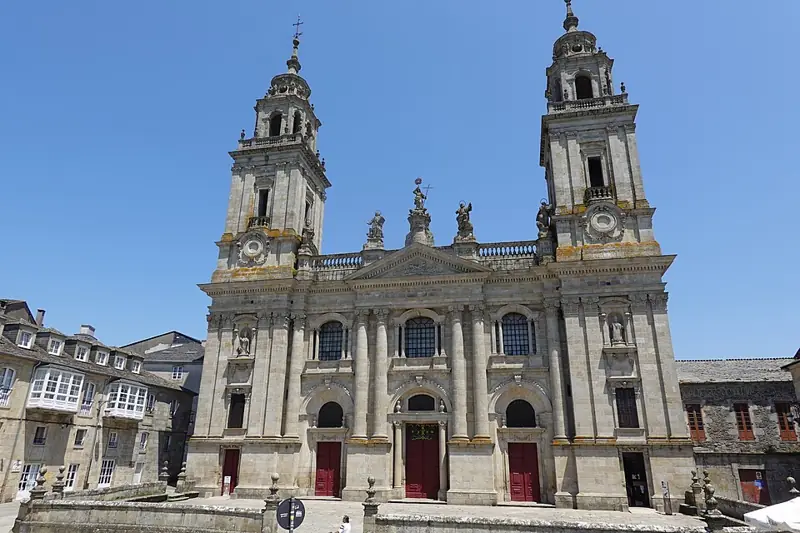
The cathedral invites you to compare periods rather than seek a single style. Romanesque origins coexist with Gothic, Renaissance, Baroque and Neoclassical additions, each changing spaces without erasing everything before. Walk around the church and notice its relationship with squares and walls before choosing an interior visit. Check cultural admission arrangements and respect areas and times reserved for prayer and services.
This gate connects the cathedral area with the outside of the walls. Approach from both sides and compare walking through the structure with walking above it. The wall is no isolated backdrop: it still shapes routes and everyday life. Use an authorised entrance to the wall walk and check conditions first; passing through the gate does not itself provide step-free access.
More than two kilometres of enclosure reveal the scale of ancient Lucus Augusti. Above, compare the old centre with neighbourhoods outside; below, study towers, gates and changes in materials. Continuity and later transformations both matter. Choose a section to suit your time and mobility, observing signs and any conservation closures. A full circuit is not necessary to appreciate the monument's scale.
Below today's city lie a Roman house, a place of worship dedicated to Mithras and the lower wall structure. The site preserves part of a Roman house, the Mithraic temple and the wall foundations; the first-floor exhibition helps distinguish the home from the place of worship. This is preserved archaeology rather than a fully reconstructed home. Check opening and visit options; stairs, levels and routes require accessibility enquiries before booking when adaptations are needed.
The square presents Lugo as a living city as well as a monument collection. The town hall overlooks gardens, arcades and meeting places that invite a slower pace. Compare façades and find a bench before continuing towards the museum or dining streets. Municipal offices remain active: enjoy the exterior and ask about any interior visits without interrupting the building's everyday administrative work.
The museum connects your Roman walk with other periods in the province. Mosaics, sculpture and religious objects add perspectives after the walls. The former Franciscan complex also contributes its own architecture, so look beyond the display cases. Choose a few galleries for an unhurried visit and check which spaces are open, especially if seeking the cloister, garden or a particular temporary exhibition.
Beside the museum, this church preserves the memory of the Franciscan convent. Study the pointed portal and eastern volumes before entering; inside, nave length and light help explain the Gothic architecture. Museum and church are neighbours with different entrances and uses. Check church opening and respect services. Admission to one does not automatically grant access to the other, despite their shared history.
Descending to the Miño changes the scale of your visit and connects the upper city with historic routes. The bridge has Roman origins and later alterations: do not assume every stone belongs to one period. Treat this separately from the walled-centre walk, allowing for an uphill return. Wear suitable shoes, check riverside path conditions and keep clear of the water's edge.
An old-town restaurant with different dining rooms and market-led cooking. Check menus, allergens and booking; its website lists a usual Monday closure and possible holiday changes.
Seasonal Galician cooking with individual touches and a tapas option downstairs. Confirm your preferred dining format, opening, availability and allergens directly when booking.
Editorial selection based on the venues’ own websites, not a personal dining review or sponsorship. Check opening, menus, allergens and prices before visiting.
Options separate from the independent walk. The free tour is tips based; check the group price for the private tour. Verified listings advertise a Spanish-speaking guide: reading this page in English or French does not change the activity language. The private tour excludes admission tickets. Confirm meeting point, accessibility and conditions for your date. Affiliate links may earn us a commission if you book. Reviewed 19 October 2026.
Choose your old-town entrance according to arrival: Santiago is the route start, not obligatory from every accommodation. Drop luggage before the walls. Plan the uphill return before descending to the Miño.