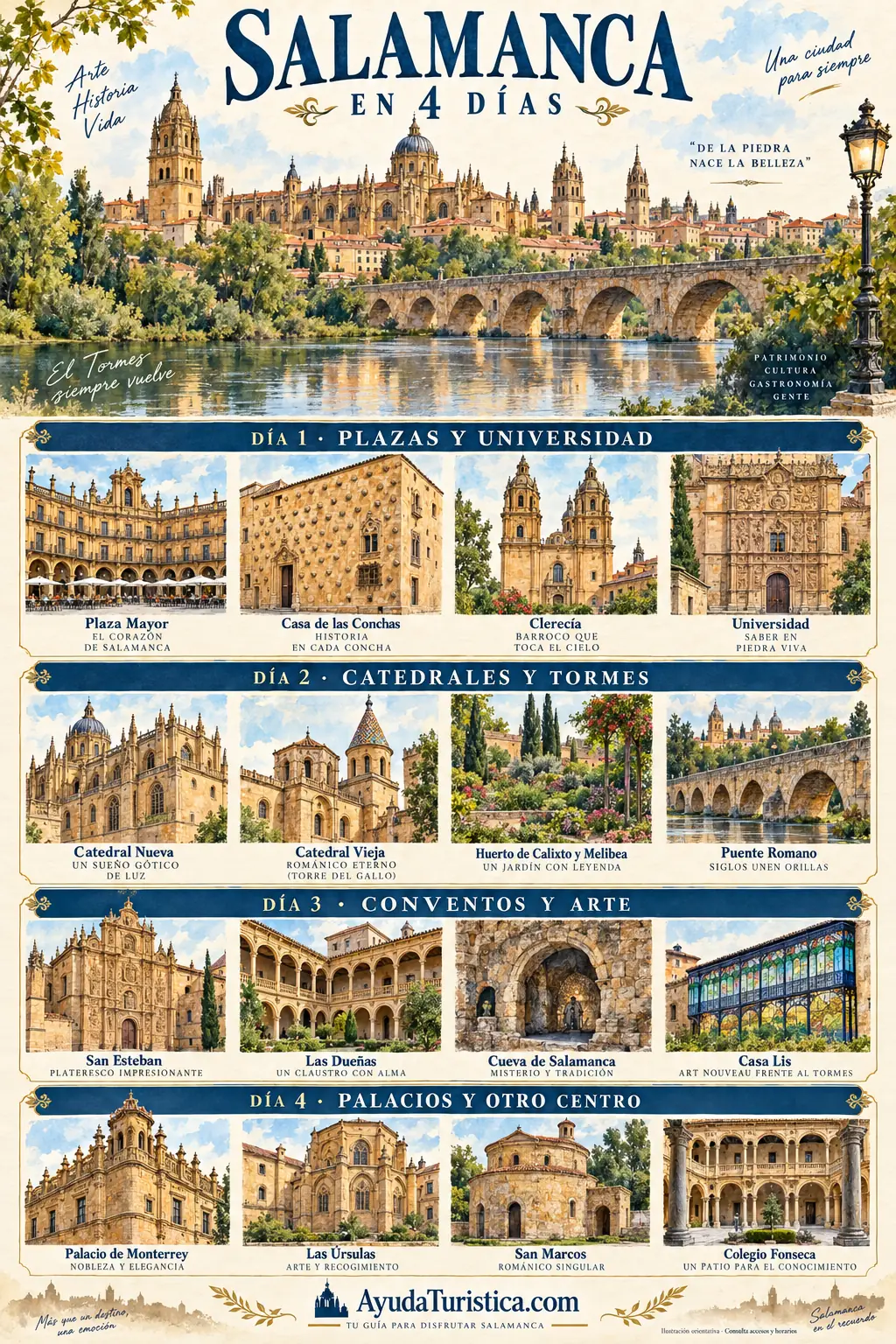
Plaza Mayor was built between 1729 and 1755 as a major public space for civic representation. Although it appears perfectly regular, its sides differ in length. Notice the medallions above the arches and the continuity of the arcades. Baroque architecture frames a setting that remains alive: a place for meeting, passing through and celebrating, rather than merely a monumental image to photograph during your visit.
The House of Shells is a noble residence from the age of the Catholic Monarchs, combining Late Gothic, Mudéjar and Renaissance elements. Its façade turns a repeated shape into a recognisable identity. Look also at the windows and relationship between ornament and wall. Its use as a library keeps the building integrated into cultural life beyond its appeal as a monument.
The Clerecía originated as the Royal College of the Holy Spirit, established to train Jesuits in the seventeenth century. Work on the church began in 1617. Notice how its façade and towers dominate the street perspective opposite the House of Shells. The ensemble expresses the connection between education, religion and monumental representation within the urban and intellectual history of Salamanca.
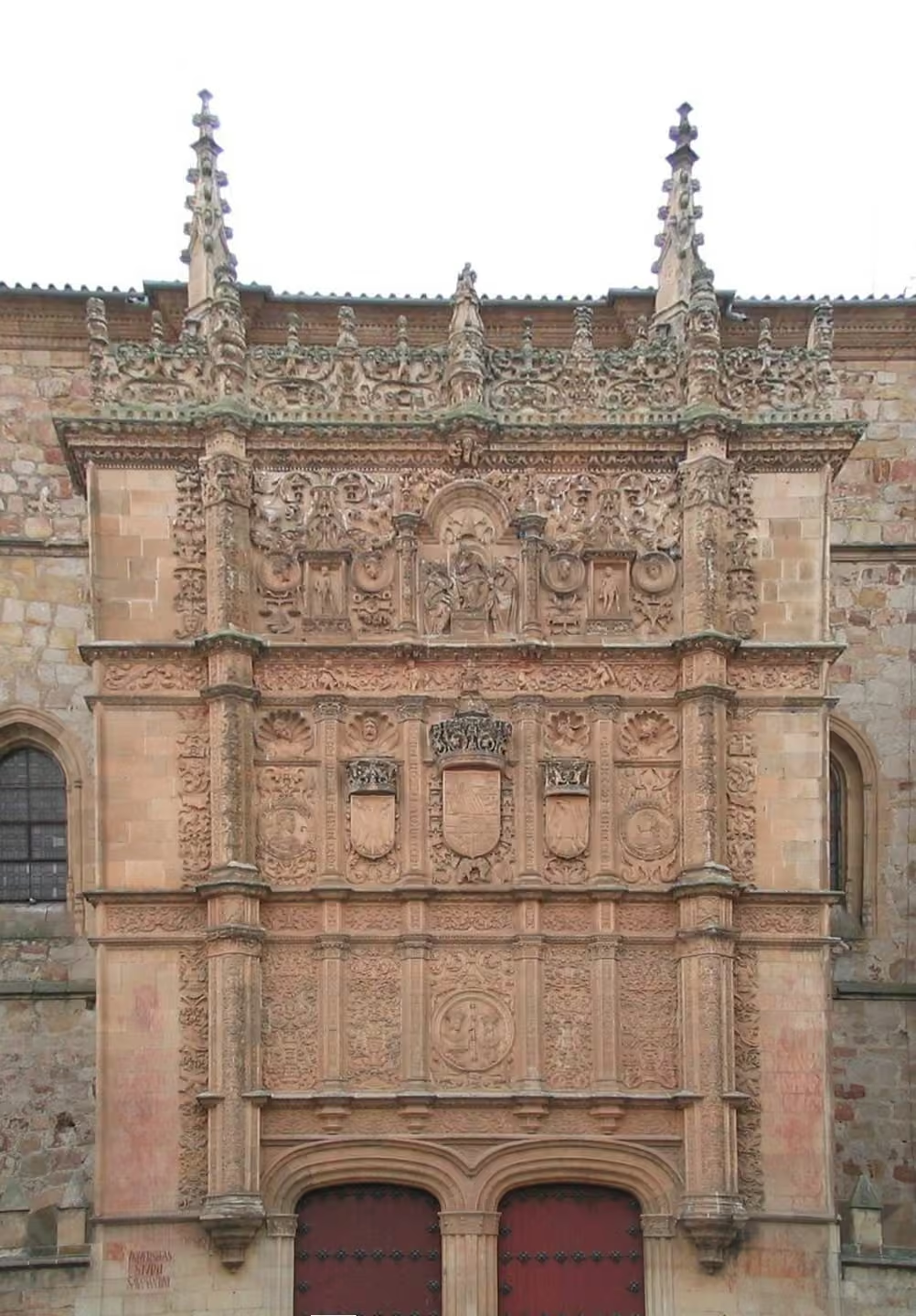
The University of Salamanca began in 1218 through the initiative of Alfonso IX of León. Its historic façade speaks of an institution that made learning part of the city's identity. Before searching for famous details, observe the whole composition from the Patio de Escuelas. Then approach the figures and coats of arms: stone also represented prestige and authority in public space.
The New and Old Cathedrals form a neighbouring complex; Ieronimus has separate access and conditions. The bridge is downhill: allow for the return climb.
Construction of the New Cathedral began in 1513 and ended in 1733. This long process explains why one building brings together different artistic stages. First observe its volume beside the Old Cathedral, then examine the doorways. The decision to preserve the earlier church reveals a history of enlargement and coexistence, rather than complete replacement, within Salamanca's most prominent religious architectural ensemble.
The Old Cathedral represents Late Romanesque architecture and retains a different scale from its large neighbour. The coexistence of two cathedrals allows you to compare periods within one ensemble. Notice the shape of the arches, the visual weight of walls and the relationship between light and stone. Its history becomes clearer when you pay attention to these architectural differences as you explore.
The garden's name refers to characters in Fernando de Rojas's La Celestina. Tradition connects this place with the work's literary imagination, without establishing it as a proven setting. Beside remains of the wall, a pause brings together greenery, views and memory. Here you can discover how a book changes the way we look at a city and imagine its past.
The Roman Bridge recalls the importance of crossing the Tormes for Salamanca's life and communications. It also belongs to the literary memory of Lazarillo, whose story is associated with this setting. Notice the rhythm of arches, then turn towards the city. Seen from below, the cathedrals and historic buildings become a shared landscape rather than a series of isolated monuments along the route.
San Esteban was an important Dominican centre of teaching and thought, associated with figures such as Francisco de Vitoria. Its Plateresque façade is arranged like a large stone altarpiece. Find the central scene first, then the levels surrounding it. This helps you understand the whole before examining individual figures: architecture and sculpture work together here as a shared visual narrative.
Las Dueñas was founded in 1419 within private houses and developed into a valuable convent complex. Its restrained entrance contrasts with the richness of the Plateresque cloister. If you enter, compare repeated arches with varied decoration. This change between outside and inside reminds you that some of Salamanca's most rewarding discoveries require looking beyond a building's street façade and first appearance.
The so-called Salamanca Cave is the crypt of the vanished Church of San Cebrián, rather than a large natural cavern. Tradition transformed it into a school of hidden knowledge and stories about the devil. Separate those legends from what you see: remains of a religious building. Its interest lies in how a real place nourished an imagination that endured for centuries.
Casa Lis introduces Art Nouveau and iron architecture into a city associated with monumental stone. Its difference is part of its appeal: Salamanca does not belong to just one period. Notice the role of glass, structure and decoration. The museum devoted to Art Nouveau and Art Deco extends this perspective towards objects in which art and everyday life meet in distinctive ways.
Monterrey Palace is a landmark of Plateresque architecture and the Spanish Renaissance. Its ornamental cresting and decorated chimneys show how residential architecture expressed power and lineage. Look at the upper silhouette before bringing your eyes down to the windows. Its impact does not depend only on size: carved details make the roofline a recognisable presence within the historic city around it.
Las Úrsulas was founded in the late fifteenth century by Sancha Maldonado and later enlarged under Archbishop Alonso de Fonseca. Its Gothic church offers a different presence from the more heavily ornamented buildings in the centre. Observe the apse and the convent's relationship with the street. This stop reveals the role of religious communities and patronage in shaping the historic city of Salamanca.
San Marcos is a Romanesque church with a circular plan, a form that distinguishes it from many churches on this route. Its compact appearance contrasts with the city's great monumental façades. Walk slowly around the exterior to understand its volume and entrances. Apparent simplicity encourages attention to proportion and construction, recalling the diversity of Salamanca's surviving medieval architectural heritage beyond its larger monuments.
Fonseca College owes its foundation to Alonso de Fonseca's patronage and forms part of the University's Renaissance heritage. Several architects contributed to its construction, reminding us that historic buildings are also collective processes. Observe the entrance and the order of the courtyard when accessible. The visit connects academic life, representation and architecture within a place still associated with the University of Salamanca.