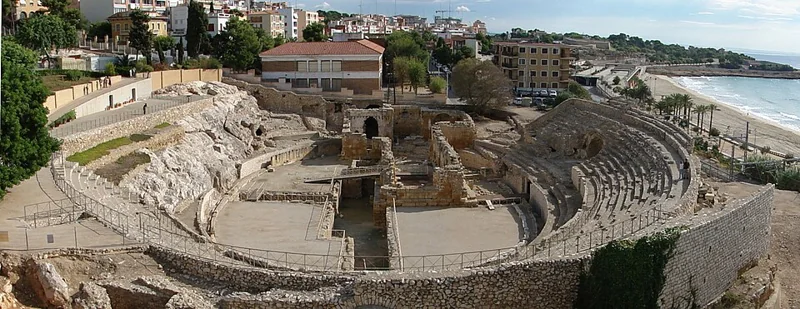
Roman heritage beside the Mediterranean, with an old town worth exploring slowly. Combine amphitheatre, circus galleries and cathedral with the Rambla and fishing quarter. The aqueduct needs a separate outing rather than a quick addition to the central walk.
Tarragona
Choose what fits your visit
Three decisions to organise the day without turning it into a checklist of tickets. Routes and time allowances are editorial suggestions; adjust the order to your bookings and pace.
01
Two Roman sites before a collection of tickets
For a first Roman half-day, we suggest choosing the Amphitheatre and Praetorium-Circus, saving the cathedral or walls for another block. The municipal calendar distinguishes sites, seasons and final admission: winter afternoon availability is not identical everywhere. Arrange those two visits first and use exterior walks as flexible connections. More tickets do not create visiting time, and arriving at closing time does not mean you can enter.
On Monday, switch from Roman interiors to city and sea
The History Museum normally lists Monday closure for the Amphitheatre, Praetorium-Circus and Archaeological Promenade, with scheduled exceptions. If your date is not an exception, we suggest Rambla Nova, the Mediterranean Balcony and a section towards El Serrallo. Exterior views are not entry to the galleries. Before rearranging everything around a closure notice, check its date: a past exceptional closure does not establish an ongoing restriction.
Pont del Diable is an outing to Les Ferreres aqueduct; El Serrallo is a harbour neighbourhood. With one afternoon remaining, we suggest choosing landscape and water engineering, or waterfront and food, rather than attempting both. The municipality lists free access to the aqueduct, but that does not arrange transport or guarantee every path. Check arrival and return before leaving the central urban area.
Begin beside the amphitheatre and climb to the Circus and Praetorium. Continue to the cathedral and finish at the walls. This sequence reveals the Roman city beneath today’s streets: choose two ticketed sites and see the rest from outside if you have only a morning.
Follow Rambla Nova to the Mediterranean Balcony, then descend towards El Serrallo with time for lunch. This maritime route balances the upper town’s monuments. Les Ferreres aqueduct is a separate transfer, not an adjoining stop on the harbour walk.
Allow a full day for wetlands, rice-field scenery and birds. Choose one area and a few hides; covering every end of the delta adds considerable driving.
By car; plan parking and your return before setting out.
Use the amphitheatre to explain Roman gatherings, then walk to the Mediterranean Balcony. Add a second site only if interest remains. The aqueduct needs a transfer; remove other interiors if including it. Beaches require another block and sea-condition checks.
In the rain
Anchor the day at the cathedral or a museum, distinguishing covered Circus and Praetorium areas from outdoor parts. Not all archaeology is indoors. Save walls and amphitheatre for a dry interval and eat near the upper town to avoid repeated climbs.
What to try and where to pause
Eat in the upper town between Roman visits or choose harbour-side Serrallo for a fish-focused meal. Decide before descending, as returning uphill adds effort. Ask about portions, price and preparation time for rice or fish dishes.
Sources for this update
Turismo de España · patrimonio de tarragona
Tarragona Turisme · patrimonio de tarragona
catedraldetarragona.com · patrimonio de tarragona
tarragona.cat · patrimonio de tarragona
Turismo de España · Delta del Ebro
Tarragona Turisme · Reus, Monasterio de Poblet
Choose your walk
Durations are indicative: queues and all indoor visits are not included.
Plan my route
Street map
OpenStreetMap loads on request. Markers are indicative, not audited entrances. Use links for street directions.
From above, let your eyes follow the oval before looking out to sea. The slope does more than frame a photograph: builders cut some northern seating into the rock, while vaulted structures supported the southern side. Dating from the early second century, the amphitheatre hosted combats and other public spectacles. Now look for a shape that interrupts the arena's geometry: the remains of a church. After Bishop Fructuosus and his deacons were martyred here in 259, the place acquired a different meaning; a Visigothic basilica and a medieval church successively occupied the enclosure. Comparing their outlines reveals a city reusing its spaces and reshaping its memory.
The vaults offer the best clue for mentally reconstructing the circus. This was no isolated stadium: parts of the Roman building remain incorporated beneath the later city. Built in the first century between the Via Augusta and the provincial forum, its long track hosted horse and chariot races. Moving between corridors, imagine the contrast between these circulation spaces and the noise of the stands. The Praetorium tower linked different levels of the monumental city through stairways; later uses also left their marks. Along the interior route, the sarcophagus of Hippolytus and Phaedra offers a change of scale, from architecture for crowds to a story carved in marble.
The steps prepare you for a building commanding the Part Alta. Before entering, compare the substantial façade with the delicacy of its rose window. Romanesque and Gothic solutions coexist because construction spanned generations, beginning in 1171 and continuing beyond its consecration in 1331. The location has an even longer continuity, occupying the former Roman imperial cult precinct. Inside, move your attention between the nave, Gothic altarpiece and Renaissance organ. Then seek out the cloister's smaller details. One carved impost depicts the procession of the rats. Its story about a cat belongs to legend, yet the scene turns a small piece of sculpture into an unexpected visual narrative.
Read the walls from the ground upwards. The large foundation blocks and upper courses create two different rhythms; following their joints reveals more than trying to take in the whole wall at once. The earliest defensive phase dates to the late third century BC, before subsequent monumental enlargements. Along the walk, towers and small gateways show how the defences continued changing over centuries. Medieval alterations mark the Archbishop's Tower, while Minerva's Tower preserves the goddess's presence in a relief. Look outwards too: the elevated position explains both the military purpose and the relationship between the walled city and its surrounding territory.
At the end of the Rambla, the promenade suddenly seems to open onto the horizon. This change of perspective helps explain why the Balcony is an everyday meeting place as well as a travel photograph. Tarragona's tocar ferro tradition makes the railing the destination of an unhurried stroll. Ramon Salas i Ricomà designed the ironwork in 1889, replacing the visual boundary previously formed by a wall beside the cliff. The viewpoint's name is associated with Emili Castelar's visit in 1863. Pause to arrange the scene in your mind: the city behind you and the coast ahead. Then turn towards the Rambla and see how its axis leads to this open ending.
After the close-knit streets of the Part Alta, the Rambla's width tells a different chapter of Tarragona. Demolition of the Sant Joan wall, begun in 1854, opened this space and improved connections between the upper city and the Marina. Walk it as a sequence from Plaça Imperial Tarraco towards the Mediterranean, pausing at façades and sculptures. The castellers monument invites you to study the collective base before the figure crowning the human tower; Julio Antonio's monument to the Heroes of 1811 introduces another strand of public memory. Here, history is shared between buildings, trees and urban conversation. The Balcony provides the walk's natural conclusion.
In El Serrallo, the city's vocabulary changes to fishermen, boats and meeting places connected with the harbour. Do more than search for a restaurant terrace. The neo-Gothic church of Sant Pere, inaugurated in 1880, recalls the fishermen's patron saint and helps locate the neighbourhood's centre. Nearby stands the former Pòsit, now restored as a cultural venue; its history of café, dancing and community life suggests the hours after work. Fishing also supports a tradition of family restaurants. Follow the public spaces and compare this neighbourhood scale with the Roman monumentality of the Part Alta. These are two Tarragona stories requiring different amounts of time, rather than interchangeable sightseeing stops.
Before approaching the arches, find a side view that lets you follow the structure's full line. The so-called Pont del Diable was built to carry water towards Tarraco, rather than carts across a ravine. It is the elevated section of a much longer channel supplied by the Francolí, distinct from the aqueduct taking water from the Gaià. Two tiers of arches support the conduit; large stone blocks were assembled without mortar. Following the repeated supports helps explain how practical infrastructure became a monumental landscape. Its position outside the centre calls for a separate outing. Allow time to observe from ground level and return, rather than rushing through a detour between urban sights.
Editorial selection based on the venues’ own websites, not a personal dining review or sponsorship. Check opening, menus, allergens and prices before visiting.
Options separate from the independent walk. Check dates, meeting point, included tickets and conditions before booking. Verified listings advertise Spanish-speaking guides: reading this guide in English or French does not change the activity language. Free tours are tips based. A general tour does not automatically include every interior on this route. Affiliate links may earn us a commission. Reviewed 19 October 2026.
Check whether your ticket arrives at Tarragona or Camp de Tarragona; these are different stations. Allow time to climb from the coast to the upper town and avoid timed admission immediately after arrival.