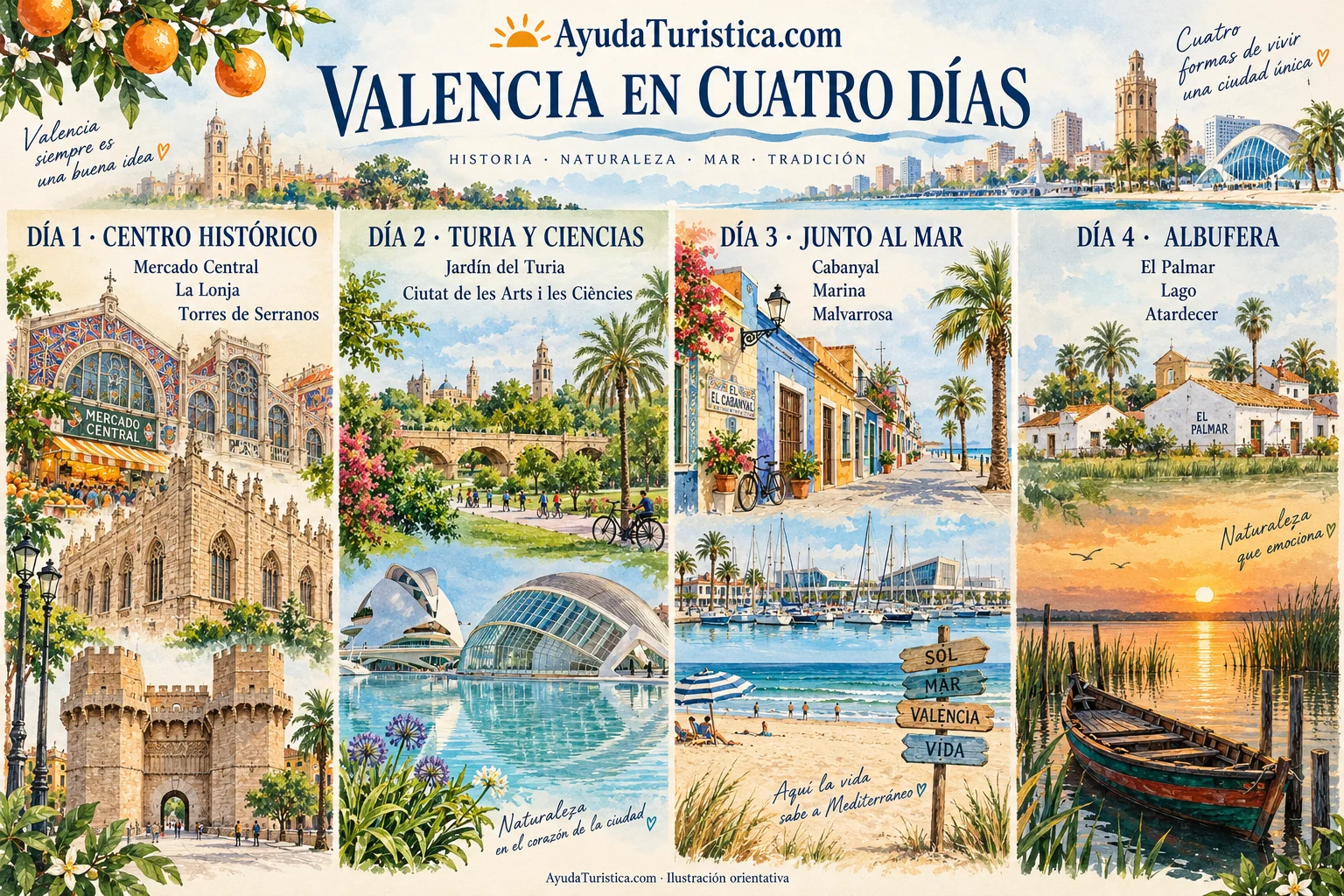
Old town, Turia, sea and Albufera across four flexible days.
Illustrated overview in Spanish. Tap to enlarge; the complete routes below are in English.
DAY 1
Historic València
Plan the market area for the morning, checking opening hours. The Silk Exchange is nearby; then continue to the squares and towers. Cathedral admission or climbing a monument is a separate choice.
Opened in 1917, the station shows how a transport building can also be a work of Modernista art. Look for plant decoration and ceramics. If entering the hall, remember that this remains a working railway station.
This square helps you get your bearings before entering the historic centre’s streets. Notice how façades frame the open space and choose a landmark to recognise on your return. From here, the walk continues towards the Central Market.
The Central Market combines Modernista architecture with everyday food trading. Look first at the structure and light, then at produce from the surrounding farmland and Mediterranean. This is a working market: keep stalls accessible and ask before photographing people.
Explore the surroundings of the market and the Silk Exchange. Walking outside does not require a ticket; check market opening hours and entry conditions for the Silk Exchange.
The Silk Exchange is a fifteenth-century Gothic building. Not every great historic building is a church: this monument represents Valencia’s civic architecture. Pause to notice its proportions.
Plaza de la Virgen brings together religious landmarks of the historic centre, including the Cathedral and Basilica of the Desamparados. Compare the open square with the surrounding streets. Seeing the ensemble outside is different from visiting each building inside.
The Serranos Towers recall a walled city where entering meant passing through a controlled gateway. Observe the two towers and central entrance. Going up is a separate visit and may be restricted by weather conditions.
Finish by the towers and the former riverbed. You can head into the garden for a break; climbing the towers is a separate visit with its own conditions.
Walk this section of the garden rather than the entire former riverbed. The final stops belong to the same complex. If you choose the Oceanogràfic, allow a substantial part of the day and save other interiors for another visit.
The giant Gulliver changes the scale of play: visitors can imagine themselves as the tiny inhabitants of Lilliput. Observe how the character becomes an activity space. Before playing, check access and the park’s instructions.
Les Arts combines architecture and performing arts. The building forms part of the City of Arts and Sciences landscape, but attending a performance or visiting inside requires separate planning. Check the programme directly with the venue.
Santiago Calatrava designed Hemisfèric as a giant eye, a metaphor for observation and knowledge. Look for its reflection in the water to complete the image. Inside is a projection theatre; check film, language and session before buying.
The museum belongs to an ensemble whose buildings have different purposes. Here, science takes centre stage. First observe the building’s shape from outside, then decide whether to devote a separate visit to the indoor exhibitions.
Oceanogràfic presents different marine ecosystems. During a visit, compare how water, landscapes and animals change between habitats. Walking outside through the City of Arts and Sciences does not include aquarium admission: it requires its own ticket.
The walk reaches the Oceanogràfic area, but going inside requires a ticket. If you choose it, allow enough time and reduce the day’s other indoor visits.
Spend a morning or afternoon in the maritime neighbourhood and on the Malvarrosa promenade. Travel from the centre by public transport and return when you wish: there is no need to walk here from the City of Arts.
Cabanyal retains an identity tied to the sea, combining neighbourhood life with cultural spaces. Observe façade details while remembering these are homes and businesses. Its interest also lies in walking the streets, rather than simply reaching the beach.
The seafront promenade reveals València’s relationship with the Mediterranean without needing to swim. Notice the changing atmosphere between sand, promenade and inland streets. If entering the water, always follow local signs and beach flags.
Plan the outward and return journey before leaving. El Palmar, walks and viewpoints are not one single stop: choose a specific plan. Boat trips are optional and depend on availability and weather.
Foto / Photo: Civitatis
Albufera is a wetland where water and birds help explain the relationship between nature and human activity. Listen and observe from permitted areas. It is outside the city centre: plan transport and the return journey as a separate outing.
The natural park deserves its own journey from the city. Choose a specific viewpoint or walk and plan your return; the map pin is a general location, not a booked boat departure point.
Gothic architecture predominates in the Cathedral, alongside elements from other periods. Compare entrances, volumes and decoration instead of looking for one uniform style. Their differences reveal the building’s changes. Distinguish cultural visits from spaces and times reserved for worship.