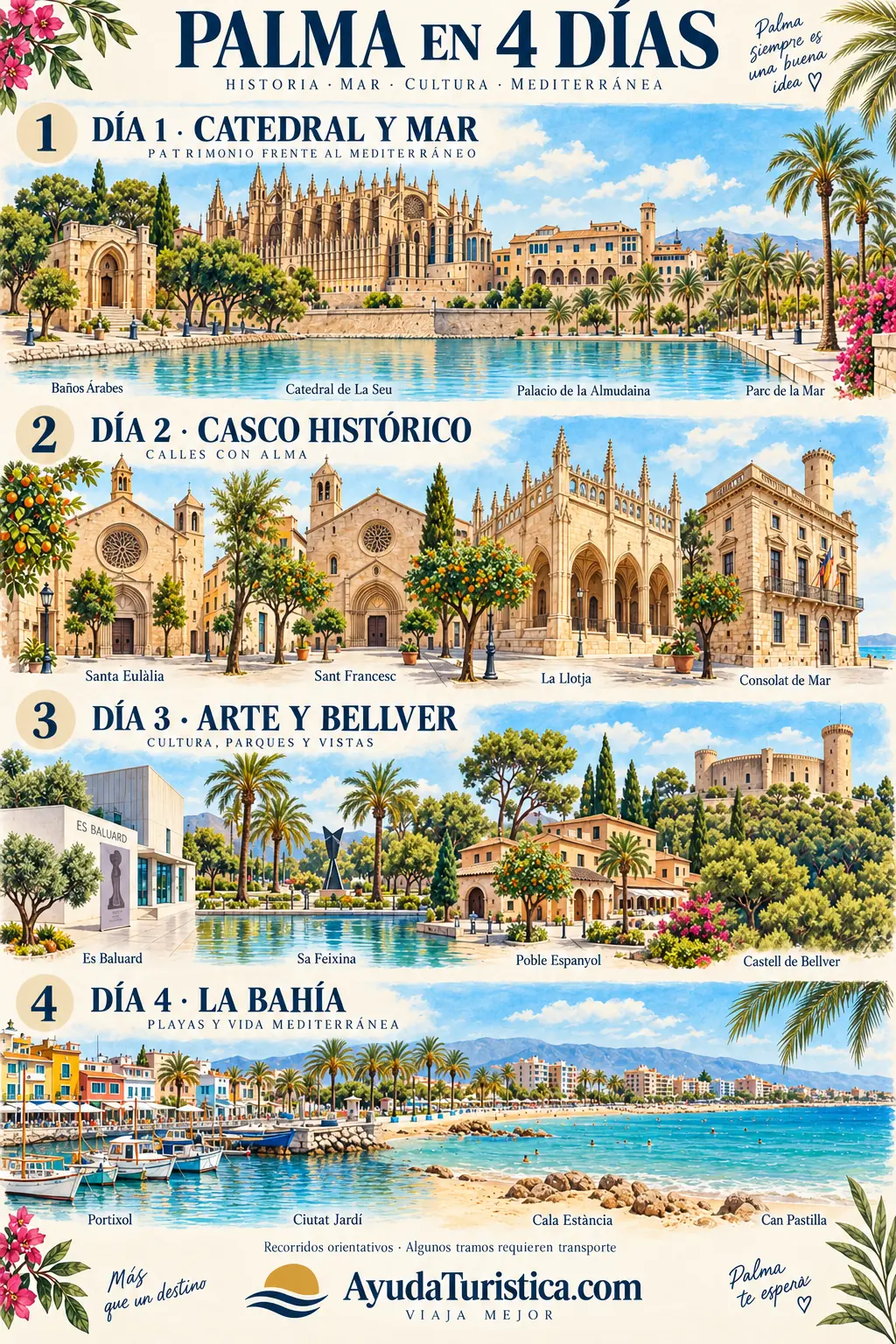
La Seu defines Palma's seaward skyline, but its artistic story continues inside. Light from the great rose window interacts with Antoni Gaudí's interventions and Miquel Barceló's ceramics. Look beyond a single overall photograph: notice colours changing across the stone and different periods coexisting within the church. Afterwards, Parc de la Mar lets you step back and recover a view of the whole ensemble.
La Almudaina brings together different layers of Palma's history, with Islamic and Christian transformations beside the Cathedral. Its role as a royal palace explains why not every part is a tourist space. Notice the fortified volumes and contrast them with the Gothic chapel of Santa Anna. From this position, the palace links political authority with both the city and the bay.
The Arab Baths preserve a trace of Palma's Islamic architecture within a garden setting. The central columned room was used for steam bathing and belonged to a private residence. Notice how the space gathers beneath its roof rather than relying on grand dimensions. The visit helps evoke domestic routines and bathing practices in the city before the Christian conquest.
Parc de la Mar gives an open view of the Cathedral and Palma's historic frontage. After narrow streets, the space around the lake lets you step back and appreciate the ensemble's scale. Look for the church's reflection, but also the relationship between walls, park and sea horizon. This pause helps place the sights you have visited within the broader cityscape.
Santa Eulàlia illustrates the difference between a church's history and the age of its façade. The side walls retain their Gothic character, while the main front and bell tower were remodelled in Neo-Gothic style in the late nineteenth and early twentieth centuries after the 1851 earthquake. Walk around the building to compare the two languages. Near Cort, the church shows Palma reinterpreting its own past.
Sant Francesc combines a Gothic church with a cloister built between the fourteenth and sixteenth centuries. The church contains the tomb of Ramon Llull, a central figure of medieval Mallorcan thought. In the cloister, notice the slender columns and shaped arches. In contrast with the church's monumental scale, the galleries offer a quieter way to experience the architectural ensemble.
La Llotja shows that Gothic architecture was not reserved for churches. Guillem Sagrera designed this meeting place for merchants, giving commercial activity an impressive architectural setting. If the interior is accessible, follow the columns upwards to meet the vaults. The continuity between supports and ceiling makes the stone appear light and helps convey the importance of trade in Palma.
The Consolat de Mar recalls the strength of Palma's maritime trade. Like nearby La Llotja, its construction was promoted by the merchants' association. Notice the five-arched gallery on the main floor and the façade's relationship with the promenade. The building acquired institutional functions, but its position beside the sea still helps explain the commercial world from which it emerged.
Es Baluard and Sa Feixina are close together. Poble Espanyol and Bellver require separate travel and involve slopes: choose according to your time and check access and return transport.
Es Baluard places contemporary art within the setting of the former Renaissance walls. The relationship between historic defences and present-day creativity is part of the experience before you even enter an exhibition. Notice how the museum opens towards the bay and Cathedral. From the terraces, compare the cityscape with the architecture framing it: heritage and contemporary Palma meet here.
Sa Feixina is a transition between the seafront route and the city. Its pedestrian space is arranged on different levels, with slopes worth considering as you walk. Notice how ramps, paths and the urban edge guide movement through the park. The interest here lies in reading an everyday public space and choosing the next section of your walk at an unhurried pace.
Poble Espanyol is not a preserved old neighbourhood but an architectural replica complex opened in the 1960s. It brings together houses, palaces, churches and other features representing different Spanish regions. Walk through its streets comparing materials, forms and details. It is best approached as an open-air collection, recognising differences between traditions without confusing the replicas with their original monuments.
Bellver is distinguished by its circular plan, unusual in a Gothic castle. The courtyard and towers organise a building that also commands the bay visually. Do not focus only on the panorama: follow the geometry of the fortress with your eyes. Its City History Museum connects the castle with Palma's development through its Roman, Islamic and Christian periods.
Choose a stretch of coast; this is not a short four-stop walk. Portixol and Ciutat Jardí can form one outing, and Cala Estància and Can Pastilla another. Check EMT connections.
Portixol lies on the coastal route linking Palma with El Molinar and the Platja de Palma area. It offers a chance to exchange monuments for the horizon and see how the promenade connects neighbourhoods. When walking, keep clear of the cycle lane. This stop is about the landscape and rhythm of the waterfront rather than a particular indoor attraction.
Ciutat Jardí offers a pause in coastal Palma, where walking and neighbourhood life shape the visit. The official city guide includes this area among the places to eat beside the sea. Before choosing a terrace, enjoy the horizon and contrast it with the stone buildings and narrow streets of the centre. This stop is about the coastal cityscape rather than an enclosed monument.
Cala Estància offers a more enclosed stretch of coast sheltered by two breakwaters. Notice how these structures shape the beach and its relationship with the waves, beside the sailing-club area. This stop reveals the coast as a landscape also changed by people. If you choose to swim, follow local information: shelter from breakwaters does not replace checking actual sea conditions.
Can Pastilla reveals a coastal Palma different from the monumental centre. Combine the seafront with the neighbourhood streets and Pius IX square, home to a regular market. Rather than a single historic façade, its interest lies in the relationship between everyday life and tourism. Notice how the pace changes between the beach and the spaces used for shopping and meeting.