The medieval Almond, two cathedrals and parks offer changing rhythms. Start with central squares and streets, setting aside time for Santa María. Artium and La Florida extend the walk; Salburua deserves a separate outing with transport and return arrangements.
Vitoria-Gasteiz
Choose what fits your visit
Three decisions to organise the day without turning it into a checklist of tickets. Routes and time allowances are editorial suggestions; adjust the order to your bookings and pace.
01
From the squares into the medieval town, with one priority
For a short first visit, orient yourself between Virgen Blanca and Plaza de España, then climb towards Machete Square. Choose Santa María as your main visit or continue exploring streets and walls. The medieval town sits on a hill: repeatedly switching between it and the lower town adds effort. Drop luggage first and plan a purposeful ascent rather than repeated returns to complete a checklist.
Artium and Florida as an alternative to a medieval day
If contemporary art and gardens appeal more, choose Artium for culture and La Florida for a later break instead of doubling religious interiors. The New Cathedral belongs to that other urban area; it is not Santa María in the medieval town. You can explore its surroundings without adding a second museum visit. This alternative works because of its different subject, not merely as a fallback for unavailable tickets.
Santa María: choose the visit format before climbing
The Foundation recommends booking Santa María and offers different formats, including cathedral, cathedral with tower and cathedral with wall. Choose the content before arranging your walk: wanting the tower panorama is not the same as purchasing any cathedral visit. Confirm the reception point stated in your booking. This avoids reaching the facade expecting unrestricted, immediate admission to every part of the complex.
Get your bearings at Virgen Blanca and Plaza de España, then climb to Machete and cross the old town to Santa María. Build the walk around your cathedral booking. Continue towards the walls and descend slowly: the old town stands on a hill.
Spend one block at Artium, then return through Plaza de España towards La Florida and the New Cathedral. This complements the medieval route with contemporary art and greenery; visiting every interior requires a longer morning or two afternoons.
Choose a short old-town mission: spot murals and compare squares before La Florida. Museums need not all be compulsory. For wildlife, Salburua deserves a separate block and transfer rather than a final stop after the hill walk.
In the rain
Artium lets you focus on contemporary art without crossing the whole city. Choose an exhibition and a few works to discuss. A booked Santa María visit is another option, with different arrangements from a freely accessible church.
What to try and where to pause
Try two or three central pintxo bars and ask for their speciality. For a seated meal, reserve; pintxos are not assumed free with drinks. Keep Rioja Alavesa winery transport and tastings separate from the city meal plan.
Sources for this update
Turismo de España · patrimonio de vitoria-gasteiz
Ayuntamiento de Vitoria-Gasteiz · Turismo · patrimonio de vitoria-gasteiz
catedralvitoria.eus · patrimonio de vitoria-gasteiz
artium.eus · patrimonio de vitoria-gasteiz
Turismo Euskadi · patrimonio de vitoria-gasteiz
Ayuntamiento de Vitoria-Gasteiz · Turismo · Salburua
Turismo Euskadi · Laguardia
Turismo Euskadi · Valle Salado de Añana
Choose your walk
Durations are indicative: queues and all indoor visits are not included.
Plan my route
Street map
OpenStreetMap loads on request. Markers are indicative, not audited entrances. Use links for street directions.
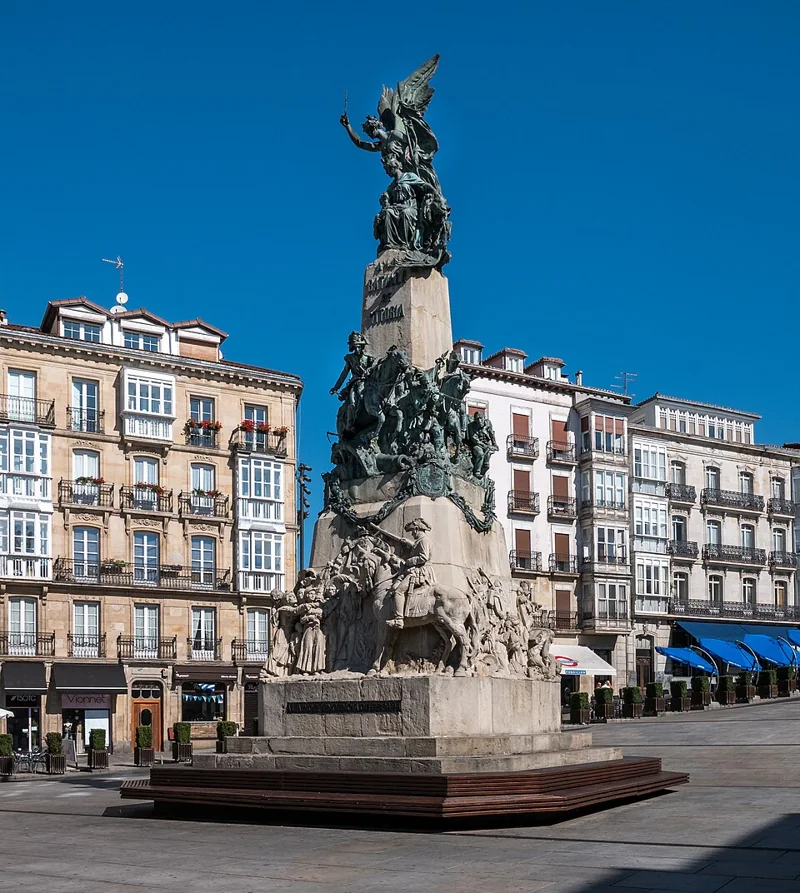
Virgen Blanca reveals a city built on a slope: the medieval Almond rises behind its façades. The monument to the Battle of Vitoria was inaugurated in 1917, while the planted sculpture spelling the city’s name arrived in 2012. These landmarks represent different ways of expressing Vitoria-Gasteiz in public space. Begin with the whole scene from the lower end, then approach the monument and compare its mass with the houses behind it. From the steps of San Miguel, turn around to see how gaining height changes the square. A photograph beside the letters can be one stop, but is not the whole visit. Watch residents crossing and notice how entrances connect: the square acts as a hinge between the historic climb and the more recent city centre.
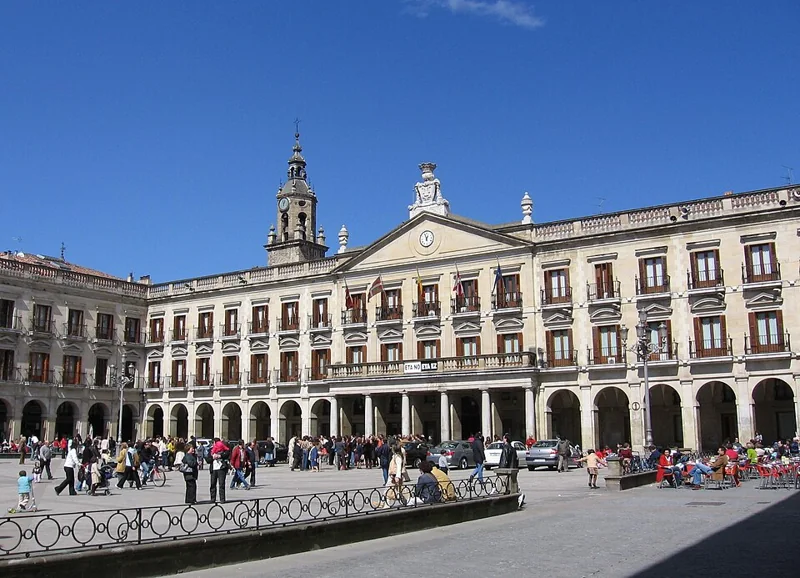
Plaza de España offers a pause of regular geometry after the curves and slopes of the medieval quarter. Justo Antonio de Olaguíbel directed its construction in the late eighteenth century as part of the Neoclassical expansion. The town hall occupies the northern wing, identified by the coat of arms above its triangular pediment. First follow the arcades, noticing the repeated arches and pilasters; then move towards the centre to understand the whole composition. Uniformity makes small differences, such as an entrance or institutional marker, more noticeable. Returning towards Mateo Moraza, look for the connection with Los Arquillos: the square was not conceived in isolation, but to link parts of the city. It is also a useful place to reconsider your route before climbing towards Machete.
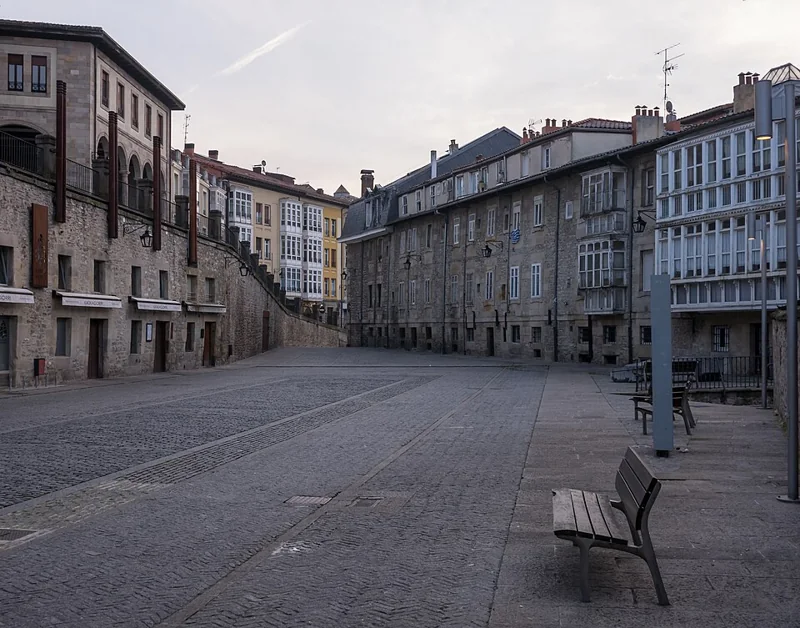
Machete’s name refers to an act of government rather than merely a picturesque tale: city representatives swore their oaths of office on this weapon. A replica and an inscribed plaque outside San Miguel connect the story with a specific place. Read them before exploring the rest of the square. Villa Suso, completed in 1542, adds another layer to a space that once marked the medieval town’s boundary. Compare the palace with the church wall and the exits towards Los Arquillos: materials, heights and viewpoints change within a few steps. Rather than expecting a broad open square, enjoy an enclosure revealed in stages. To continue towards Santa María, choose a route appropriate to your mobility and allow time for the slopes instead of treating the connection as a level street.
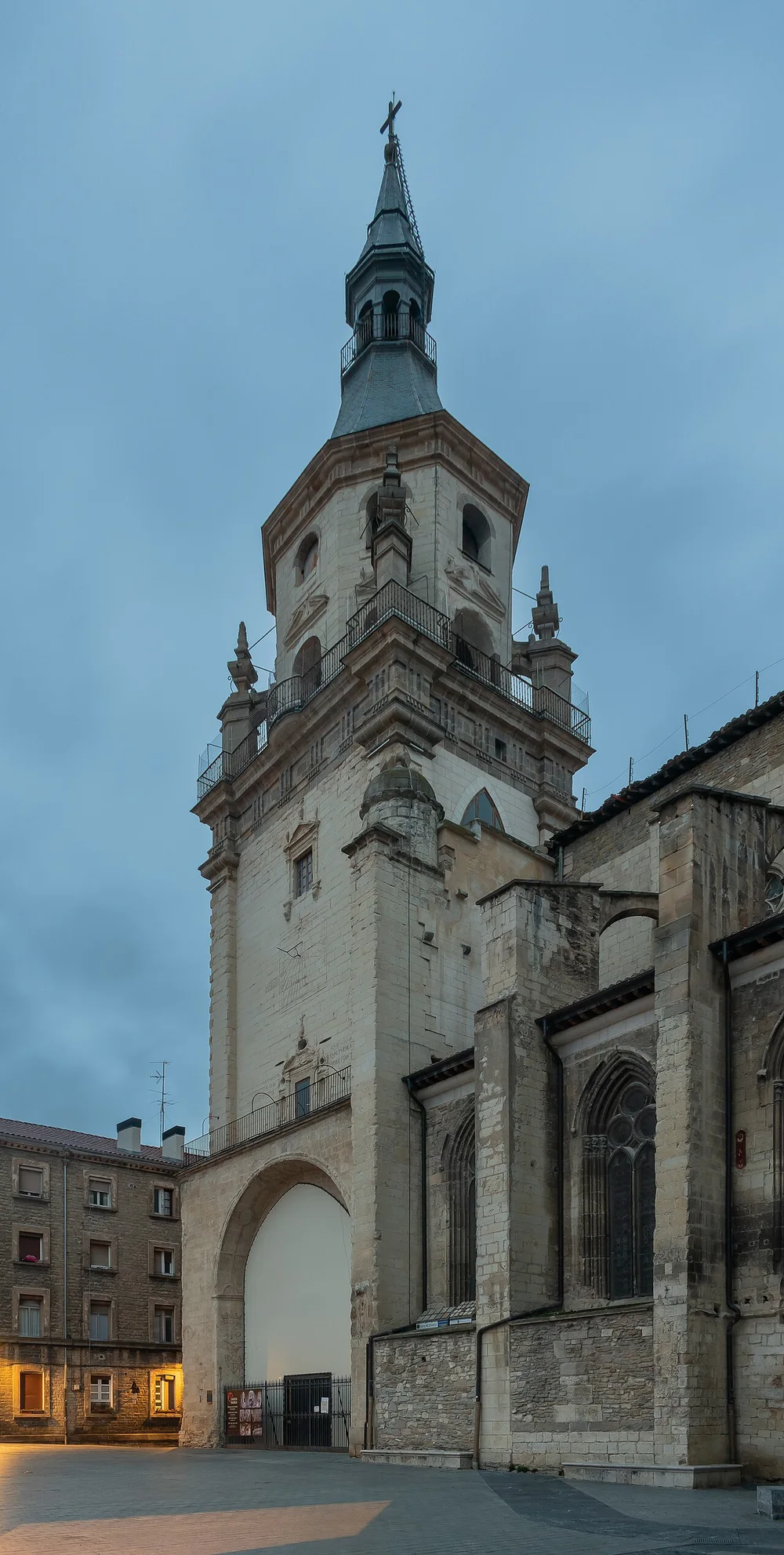
Santa María tells Gasteiz’s evolution through structural problems and repairs as well as architecture. The church became a cathedral in 1862; difficulties forced its closure in 1994, and restoration has been shared with visitors through the Open for Restoration programme since 1999. This changes the experience: instead of viewing only a finished monument, you can understand how a historic building is studied and conserved. Ask what each intervention reveals, looking for differences between inherited fabric and additions made during recovery. This is the cathedral high in the old town, not the New Cathedral beside La Florida. Check your booked visit format and reception point, since included spaces depend on the route. Allow time to arrive through the Almond’s streets and hear the explanation before concentrating on a single interior photograph.
Do not imagine the wall as a fortress isolated from houses: surviving sections and restorations are integrated into the old town. Municipal information identifies parts of the eleventh-century first enclosure beside Escoriaza-Esquivel and Villa Suso; at the latter, a timber structure restores the original height and wall walk. First notice where surviving stone ends and contemporary intervention begins. This distinction adds interest, explaining how a defence absorbed into later buildings is made visible again. Then consider its relationship with gardens, homes and the slope. Different sections do not necessarily share entrances or visiting arrangements, so check the particular stretch before relying on an organised access or walkway. The walk makes sense by connecting fragments rather than expecting an intact enclosure that can be circled in one continuous visit.
Artium begins before the galleries. José Luis Catón’s building places much of its space below street level, organised around an internal square containing the Lorategi garden. This makes the museum more than an object viewed from outside: it is also an open space within an inhabited neighbourhood. Before entering, compare the emerging volumes with the breadth of the square. Inside, change your approach from the monumental walk: choose one work, study its materials and give yourself a few minutes before reading the explanation. Collections and exhibitions may pose questions rather than tell a closed historical narrative. Check the current programme and select what you want to visit. Not every collection work is permanently displayed, and family workshops should be checked separately rather than assumed to happen every day.
La Florida was created in 1820 with inspiration from French Romantic gardens. Paths, grotto, water and bandstand form a sequence that makes the grounds seem larger, replacing straight lines with small discoveries. Enter without searching for the quickest shortcut to your next visit: choose a path whose end you cannot see and notice how viewpoints change as you proceed. Then find a bench overlooking trees, clearings and movement through the park. It provides a useful counterpoint to Plaza de España’s geometry and the Almond’s streets. Let the pause last as long as you need, without turning the garden into another checklist of monuments. Remember that it remains an outdoor space: in rain, its paths and resting places are not equivalent to a covered refuge.
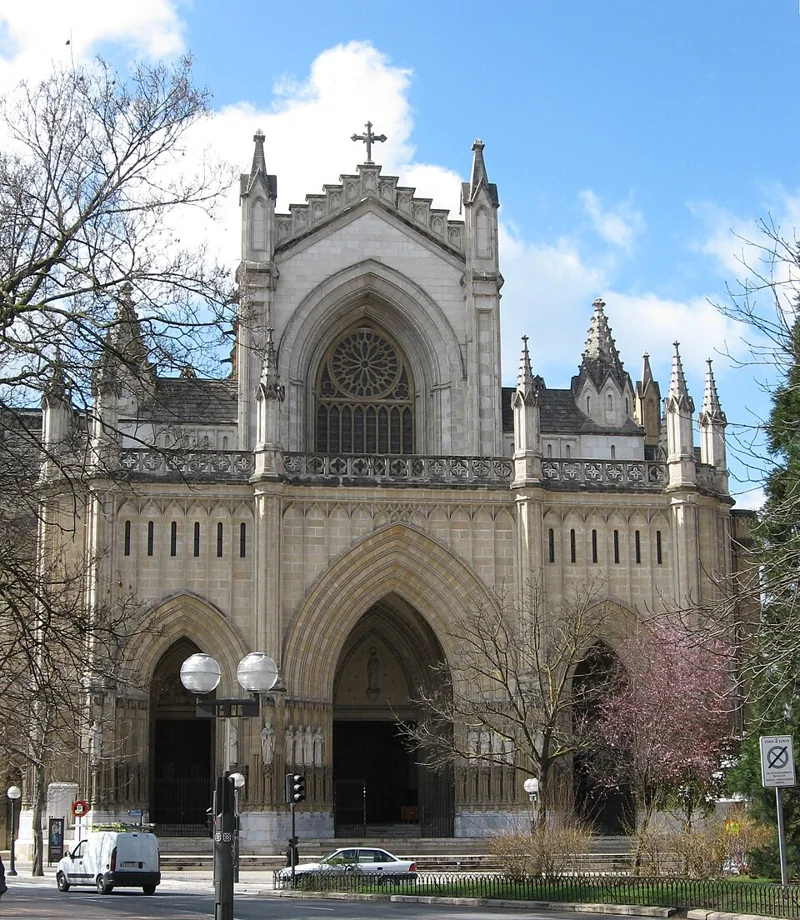
The New Cathedral demonstrates that a Gothic appearance need not mean a medieval date. Construction of this Neo-Gothic building began in 1907, and it was consecrated in 1969; five lofty naves are lit by Maumejean stained glass. Begin by viewing its mass from around La Florida to understand the scale, then approach the stone decoration. Comparison with Santa María distinguishes a revived artistic language from a medieval building transformed over centuries. The Diocesan Museum of Sacred Art occupies space within the complex, but should be planned as a visit in its own right. Check church opening and museum arrangements separately. Inside, find a quiet viewpoint from which to follow the lines of the naves and notice how changing light alters the colour of the stone.
Dining in a historic building can complement the medieval walk. Confirm booking, meal format and menu; the informal dining area may run different services.
Editorial selection based on the venues’ own websites, not a personal dining review or sponsorship. Check opening, menus, allergens and prices before visiting.
Options separate from the independent walk. Check dates, meeting point, included tickets and conditions before booking. Verified listings advertise Spanish-speaking guides: reading this guide in English or French does not change the activity language. Free tours are tips based. A general tour does not automatically include every interior on this route. Affiliate links may earn us a commission. Reviewed 19 October 2026.
Use Virgen Blanca as your starting reference and allow a separate station transfer. Drop luggage before the uphill old town. Build the walk around your Santa María visit time rather than expecting walk-in entry.