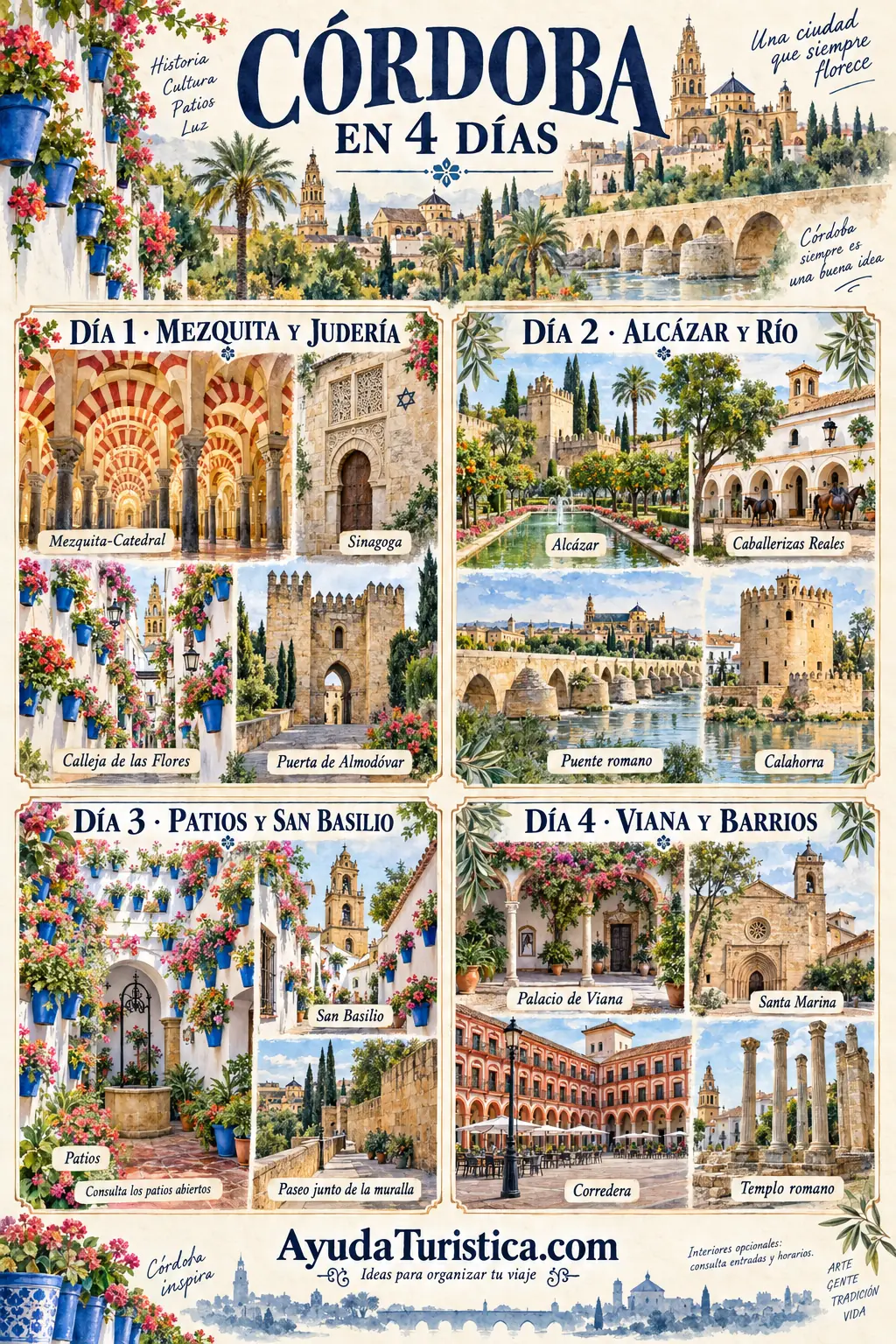
The Mosque-Cathedral brings together a complex history of building and transformation. Abd al-Rahman I initiated the congregational mosque and his successors expanded it, linking worship with the representation of power. Notice how repeated supports create views that change as you walk. Do not search for a single period: part of the monument’s interest lies in recognising its historical layers and taking time with their differences.
Calleja de las Flores lies in the Jewish quarter near the Mosque-Cathedral. Its appeal is intimate in scale: walls, flowers and perspective create a scene revealed as you move. Look first at the whole, then at smaller details, keeping the passage clear when taking photographs. This short stop shows how small streets also shape Córdoba’s identity.
Inscriptions date the Synagogue’s construction to 1314–1315. Its small entrance leads to a room whose Mudéjar decoration contrasts with its modest size. Observe the plasterwork and the arches of the upper gallery. After 1492 the building served other purposes, including hospital and chapel. Its survival preserves an essential part of Córdoba’s Jewish history within the fabric of the old town.
The Puerta de Almodóvar recalls how gates and walls once defined the historic city. Its medieval history invites you to see the city as an enclosed space with controlled thresholds. Observe the passage from one side to the other and follow the wall with your eyes. A gate was more than a monument: it organised movement and connections with the outside world.
The Alcázar combines fortress, residence and garden on a site transformed by successive rulers. Its later history includes use by the Inquisition and as a prison. Notice the contrast between defensive walls and courtyards with water and plants. Inside, Roman mosaics remind you that the history of this place predates the medieval building visible from outside.
Philip II founded the Royal Stables in 1572 to breed horses for the royal household. Their position beside the Alcázar connects the history of horses with royal power. The building suffered a major fire and later reconstruction. During your visit, notice how its architecture organises the spaces for animals: this is heritage designed around a very specific practical purpose.
The bridge originated in the first century, but its appearance also reflects medieval and later interventions. Imagine it as infrastructure adapted over centuries rather than an untouched Roman object. As you cross, notice the sequence of arches and the relationship between river and city. Looking towards both banks helps explain why this crossing played such an important role in Córdoba’s history.
The Calahorra stands at the southern end of the Roman Bridge, a key position for controlling the river crossing. Its architecture reflects successive alterations rather than one single building campaign. Today it houses the Living Museum of al-Andalus. Before entering or moving on, observe the relationship between tower, bridge and riverbank: their arrangement explains the building’s former defensive role.
San Basilio is a key area for discovering Córdoba’s courtyards. Their appeal includes both flowers and architecture and the work of people who care for them. Not every door is open and visits operate in different ways, so check the arrangements before entering. A courtyard may belong to someone’s home; visit with respect for residents and their everyday peace.
Plaza del Potro recalls a place where livestock was traded and craftspeople worked. The small horse on its fountain is one of its visual landmarks. The old inn and the square’s museums connect different uses of the same urban space. Before moving on, walk around its edges and notice how the scale of the buildings frames the fountain.
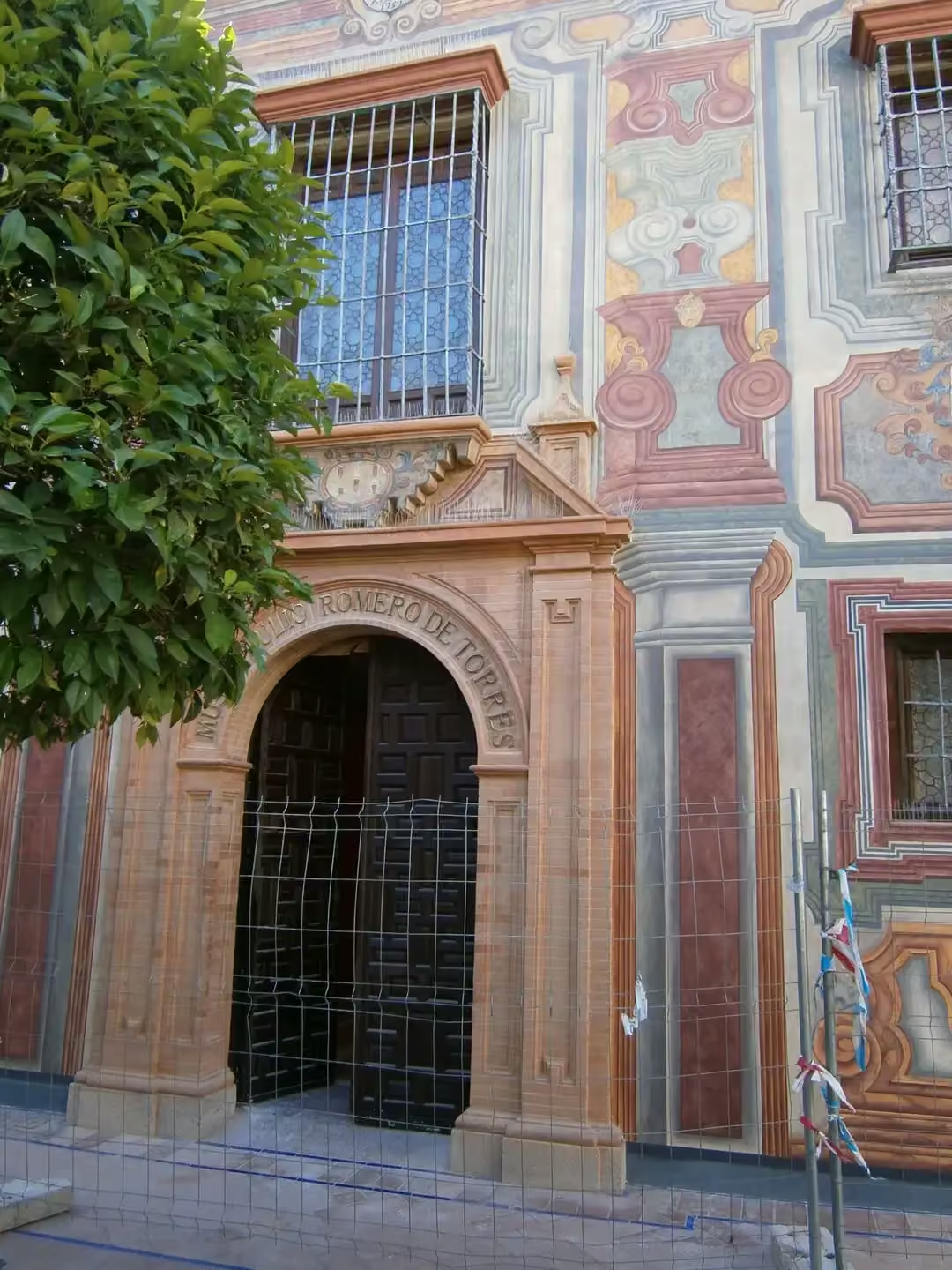
The museum devoted to Julio Romero de Torres stands on Plaza del Potro beside other cultural spaces. It offers a change of pace, from walking through the city to looking closely at painting. Choose one work and spend time on expression, posture and background before moving on. The square around the museum connects the artistic visit with your wider urban route.
The Corredera is a monumental seventeenth-century square that changes the scale of the walk after the old town’s narrow streets. Pause at one end to take in the whole before approaching the façades. Its central space and edges suggest two ways of using a square: crossing it or staying. It works as an urban pause without requiring an indoor visit.
This first-century temple was dedicated to the imperial cult and formed part of an important Roman public complex. The visible columns help convey its scale, but what you see also includes modern reconstruction. Notice their height and the raised platform. The stop recalls Córdoba’s political importance long before its Islamic and Christian periods, adding another layer to the urban walk.
Viana Palace invites you to explore domestic architecture through its courtyards. Instead of searching for a single monumental view, compare transitions between spaces, planting, shade and light. Each courtyard changes the pace of the visit. Spending a few minutes noticing their differences reveals why the whole is richer than a straightforward succession of gardens.
Construction of Santa Marina began in the late thirteenth century, combining late Romanesque, Gothic and Mudéjar forms. Changes in later centuries added further layers. From the square, look at the rose window and the walls’ almost fortified appearance. Comparing these features with other churches on your walk reveals why a historic church does not always belong to a single architectural style.
This fifteenth-century detached defensive tower was built above an earlier Islamic structure and linked to the wall by an arch. Its name is surrounded by a legend of jealousy and death, which should be distinguished from the building’s documented history. Observe the tower’s shape and elevated connection: these reveal its defensive role more clearly than the legendary story.