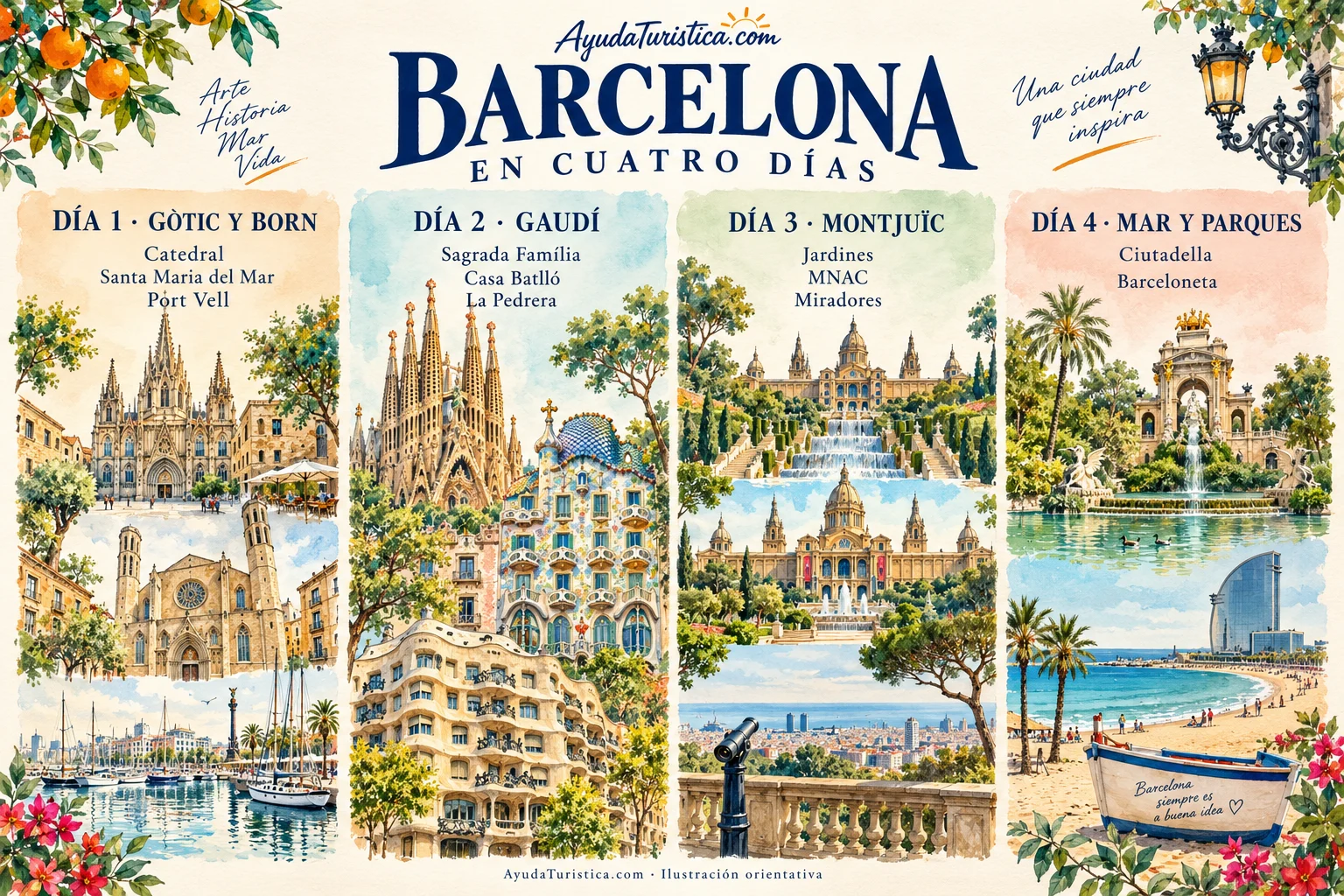
Four area-based days combining neighbourhoods, architecture and the sea.
Illustrated overview in Spanish. Tap to enlarge; the complete routes below are in English.
DAY 1
Gothic Quarter, El Born and Port Vell
Start in the morning and pause in El Born before reaching the harbour. This order takes you towards the sea without returning to the start. If you add a museum, shorten the remaining walk.
The square connects the old town with the Eixample and serves as a meeting place. Compare the streets leaving it: some lead into the old street network, others into the expanded city. Their difference helps explain Barcelona.
The Cathedral is a religious and urban landmark in the Gothic Quarter. Pause in the square and compare the building’s scale with the streets leading into it. The exterior walk, cultural visit and access to areas such as rooftops are different experiences.
Sant Jaume brings together City Hall and the Generalitat headquarters. Compare the facing façades: the square expresses the continuity of political life in the city’s heart. Seeing the square does not mean the institutional buildings are open for visits.
Santa Maria del Mar was built between 1329 and 1384 and is a landmark of Catalan Gothic architecture. Observe its proportions before focusing on decoration. Inside, look at the relationship between columns and space; check rooftop visit conditions separately.
Port Vell reveals Barcelona’s relationship with the sea. Observe boats, promenades and waterfront buildings together. The harbour’s public areas can be explored on foot; boat activities and visitor attractions have their own admission and access arrangements.
Start on Passeig de Gràcia and finish at the Sagrada Família. The final stretch is longer: transport is an option. Choose one main indoor visit; Park Güell needs a separate journey and is not part of this continuous walk.
Gaudí transformed an existing Passeig de Gràcia building into a work of remarkable creative freedom. From the street, compare colours, curves and balconies with neighbouring buildings. The exterior belongs to the walk; the indoor experience requires a separate visit.
Casa Milà, known as La Pedrera, stands out for its undulating façade. Notice how lines flow between balconies rather than forming a rigid grid. Visiting interior spaces and the roof requires checking the chosen ticket option.
The Sagrada Família is Antoni Gaudí’s great Barcelona project, developed over several generations. Compare its façades before entering: they offer different perspectives on the building.
Look at the façades from outside before your visit. If you have a ticket, use the entrance specified on your booking; a street walk does not include basilica admission.
Combine views from the Palau Nacional with an optional trip up to the castle. Expect slopes and steps: check the access that suits you. Do not assume fountain shows or facilities are operating without checking their schedules.
MNAC is housed in the Palau Nacional, built for the 1929 International Exhibition. Distinguish the building’s importance from its collections. Outside, observe its position on Montjuïc; allow a separate visit to explore the galleries.
The castle stands high above the harbour. Its position helps explain its military role and views. Before going up, plan the outward and return journeys: it is not at waterfront level. Interior visits have their own conditions.
Spend your last day in Ciutadella and along the seafront. Finish at Port Vell or stay near the beach. With children or hot weather, reduce the distance and allow time to sit down.
The park occupies a former military citadel and preserves reminders of the 1888 Universal Exhibition. Its cascade and buildings show how a garden can tell urban history. Combine observing these features with a break beneath the trees.
Barceloneta occupies a strip between harbour and beaches. Its straight, narrow streets reveal a planned neighbourhood, unlike the old town’s street patterns. Observe this layout before reaching the sea and respect residents’ everyday life.
Montjuïc is not one monument: it combines gardens, museums, viewpoints and a castle. The slope matters when planning. Choose a section rather than treating every attraction as nearby stops on a flat walk. Transport and venues have separate conditions.